Showing posts with label James Cameron. Show all posts

Monday, January 21, 2019

REVIEW: Avatar


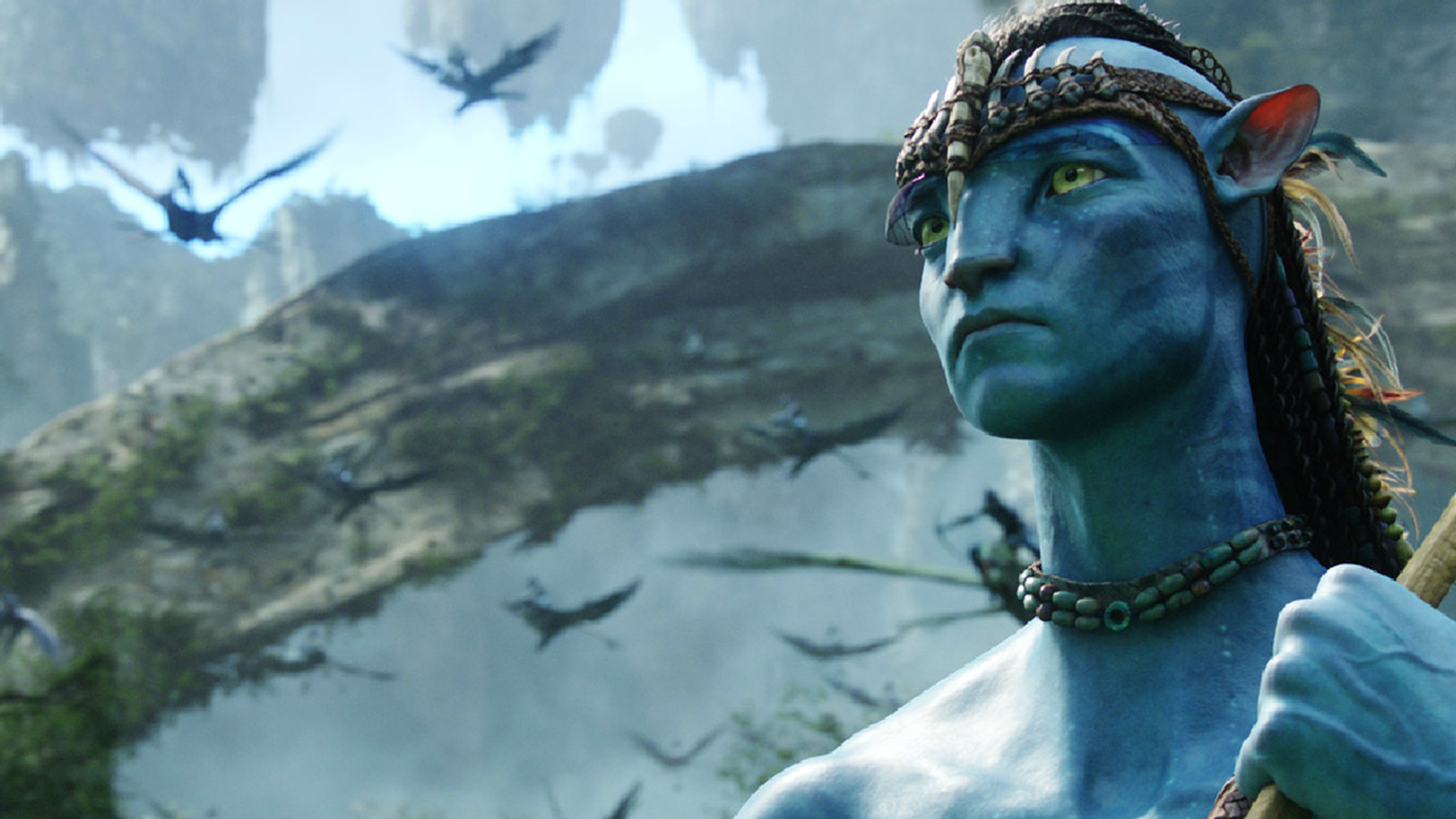
It's been almost a decade since the biggest blockbuster in history came out, and I finally got around to seeing it.  I felt like the only person on the planet that hadn't seen it, with everyone rushing out to see the technical mastery of director James Cameron and how the movie incorporated 3D.  I also feel like the only person on the planet who thought Inception was 'meh.'  Sometimes, I have learned, I stand alone.

Cameron had a definite vision for this movie, and he has been pushing the boundaries of special effects and environment his entire career.  He doesn't seem to be able to give something less than 100%, and Avatar was his biggest masterpiece.  The visual world that he created was imaginative beyond compare.  The contrast of light and colours on the fictional planet of Pandora was glorious eye candy.  That being said, I didn't see this film in theatres.  I didn't see it in 3D.  I saw it on a laptop screen, and the CGI was obvious in some of the actions of the alien species, the Na'vi. That's minor, because when it came out it was without any contemporaries.  It was a massive hit, got nine Oscar nominations, three wins, and made $2.78 billion worldwide.  I cannot see it getting dethroned any time in the near future, so it's status as a mega-hit will remain.

But...

This is an example of insanely simplistic storytelling.  Yes, it blew minds and people ranted and raved, but the actual tale that's being told is incredibly generic, and the entire plot of the film (which means the film itself) had no reason to exist (I'll expand on this a bit later).  If you doubt me about the poor quality of its story, look at what happened when the film was no longer in theatres.  I don't know of anyone that owns a copy of Avatar.  I am never talking to friends of mine who are parents who excitedly tell me that they just showed their child Avatar for the first time.  Once the glamour of the film is pulled away, the ground breaking use of 3D, there isn't much left to excite people.  This is the biggest movie of modern cinema, and it didn't take long for it to stop being talked about.

This movie is easily the biggest 'white saviour' movie that has been told.  If that term is new to you, it refers to the fact that the problems of a different group of people are overcome by a white guy (seldom a female).  Not only is the main character, Jake Sully (Sam Worthington) able to prove his worth to the Na'vi, it is him who ultimately has the courage and determination to lead them to victory when they are unable to do it themselves.  Movies like this should have gone extinct a long time ago, and yet they still happen.

Normally by this point in a review I would have said at least something about the plot of the movie I am reviewing.  Notice how I haven't done that yet?  It's because the plot has no reason to exist, and that's not based off of my interpretation, it is based off of the script.  Humans have a program where they take highly educated people with PhDs and essentially get them to drive around Na'vi bodies, which they call avatars.  They use 50% DNA from the human and 50% DNA from a Na'vi to create a creature that has a biological connection to its operator.  The human then goes in a pod and is able to bring the Na'vi body to life and control everything it does.  Because this program needs highly educated people who have trained for years on Na'vi culture and language (as well as it taking five years for those people to get to the planet), I assumed that all of this effort was for humans to infiltrate the Na'vi.  Why else would they have such an elaborate program?

Well, my friends, this isn't the case.  We learn quickly that the Na'vi know that the people coming to them aren't native to the planet, as they refer to them as 'sky people.'  "Okay," I thought, "obviously the humans have gone through all of this work because the Na'vi will have their minds blown if they saw someone in human form approaching them."  Not the case at all.  At the end they are presented both the human driver and their avatar they don't even do a double take.  In fact, they are so comfortable with it that I assume they must have known the entire time.  The fact that the human has been controlling the avatar is laid in front of them, and it is clear they aren't surprised by this.  There is no actual reason presented in the film why it is they have to resort to using avatars when they could just meet with the Na'vi in person.

The movie's entire plot is useless.  It is about a far-fetched program that would be costly as heck, take almost a decade to train and re-locate someone to drive an avatar, and is is inefficient as feeding unleaded gasoline to a mule to get him to go faster.  We are never given any reason why this entire avatar initiative is required, and people could have been meeting with the Na'vi in jeans and a tank top the entire time.

Add on to this the lack of subtlety in the film, and we aren't really looking at something that should have been nominated for a best picture Oscar.  The humans want something that they can't have because the Na'vi are situated on it, and it is called, 'unobtainium.'  Seriously, that is what it's called.  It has the poetic sting of a Limerick scrawled on the bathroom stall at a run down truck stop.  The main villain is a hard core military man who is about as cartoony caricature as you can get.  Seeing him walk around with his chest puffed out made me smirk almost every time I saw him.

Luckily there are a few things that are present to try and save the film.  The world that is created is absolutely beautiful.  The experience, even when not seen in 3D, is incredibly immersive.  There was such imagination and artistry that were poured into the film that it almost makes up for its flaws.  The action is well directed and well paced, which isn't a surprise since it's James Cameron.  It's just too bad the plot literally makes it so that the plot doesn't need to exist, and actually shouldn't exist.

It can be said that Cameron also had a very simplistic story in Titanic, and that would be true.  However, with Titanic we were given leads that were likeable.  While the story may have also had a cartoony villain in Billy Zane's character, the core of the tale was nice enough that it wasn't insulting. James Cameron is undeniably one of the most talented directors ever from a technical standpoint.  He can create content that relocates the theatre audience and places them in brilliantly created environments.  Storytelling, though, is not his strong suit.  I believe that he has story ideas that would cause him to create the next two Avatar films that are going to come out, but I don't believe they are guaranteed to be good.

Rating - 2.5 out of 3 stars

Saturday, November 30, 2013

Aliens


Yesterday I took a look at a film that tried to re-establish the fun of a franchise that was created back in 1987.  Predators is one half of a franchise duo that came together in 2004 with AVP: Alien vs. Predator, a film that took what little hope was left from two stagnant brands and buried it under nothing less than unfortunate cinematic nonsense.  I figure that it is only fair to take a peek at the other half of the equation and look at Aliens, James Cameron’s sequel to Ridley Scott’s Alien.

Sequels, franchises, and fans are all fickle things that are very hard to predict.  Most of the time, the rule seems to be that a follow up film should try and capture the feel of the original and recreate the experience for the audience.  Audiences enjoy familiarity, even if they claim they don’t.  The Hangover trilogy is a great case in point.  Audiences gobbled up the sequel even though they criticised it for being an exact carbon copy of the original and made many a complaint over that fact.  When the third movie came out and left behind all similarities to the first two movies (except for the characters) audiences did not buy in and complained that it was a different movie and did not feel like one of The Hangover films.

Well, when James Cameron stepped up to the plate to sequel the insanely well received Alien (both by the public and critics alike) he not only steered clear of attempting to recreate the atmosphere of the original, but essentially took the franchise into an entirely different genre.  While they are both science fiction, Alien is best described as a horror while Aliens was created to be an action movie.  Switching the genres of a franchise may seem like an awful idea, but the result was a movie that stood on its own while still adding to the cannon of the first film.

I can tell you specifically how I first saw this movie.  I was sixteen and it was on television one night on a French station, so I stayed up late and watched the entire film in a foreign language.  My long time desire to see the movie is what made me check it out, but it was the environment created by Cameron that lured me into this world.  It mattered not that I could not tell what the people were saying, the visuals and the situations were riveting and all I wanted was more.

Watching the film again last night, I still got much of that same sense of being immersed into the realm created for this movie.  It is not just the sets that accomplish that task, but the pace of the movie as well.  Watching the director’s extended cut the action does not start for over an hour into the movie, but it is not a slow paced first hour.  A lot happens, as we get an idea of where Ripley’s (Sigourney Weaver) life is at after having survived the events of the previous chapter.  We are introduced to the faces behind the ominous ‘company’ that we find out about in Alien, and we meet the Colonial Marines who Ripley will escort back to the dark planet from the first movie.

Where some sequels fail is in the realistic set-up that would allow the events to happen a second time.  With Aliens, everything is very well explained and understood so we gain a good sense that these choices would actually happen the way they do.  We see what causes Ripley to go against all of her better judgement and return to the place of her trauma.  It is this part, in particular, that is best explained in the extended edition.  The theatrical cut does not allow us to get to know that Ripley, while lost in space, missed out on the life of her only daughter.  She has nothing left on earth, and it sets up the base line for decisions that she will take down the road.

Which leads to my only one qualm with the movie, and that is the child character, Newt.  Her functionality to the script is clear, as she is parentless and provides Ripley a chance to become a protector and provider once again.  Her role is very important in the theme of maternal protectionism in this movie (from both the side of the humans and the aliens), but she really was not cast or written very well.  Her lines are disruptive to the flow of the movie at times, and the delivery of those lines can jar you from the otherwise perfect world that James Cameron creates.

James Cameron brings over some talent from the Terminator in Lance Henriksen, Bill Paxton, and Michael Biehn (who gets his hand bit by a girl in both movies) as well as some terms that he established in the Terminator universe, such as ‘phased plasma rifles’ (yes, I am that much of a geek that I notice such things), and Hyperdyne Systems (a play on Cyberdyne Systems, the company that created Skynet in Terminator).

My own personal geekdom aside, Aliens is a visual treat, and not one that is non-stop, fist-pumping action.  The action happens in segments throughout, with a lot of time in between to understand the situation and to get a better understanding of the characters and what is at stake.  Too often we see movies that have long, uninterrupted sequences of nonsensical action (Man of Steel) instead of using it sparingly and as an element to heighten the emotional investment in the story.  Sometimes less is more, allowing the sequences to be properly built up with real consequences at hand is better than having them for the sake of it.

In Aliens, we get a well told story in a vivid environment that went a long way to establishing the foothold that this franchise stills has.  Even after multiple failures, it is the strength of Alien and Aliens that allow fans to still hold on.  For the most part, it is a movie that visually holds up today and should still entertain newcomers.  It is a great reminder that action movies do not need to always be senseless, that females can be strong leads, and that new directions for a franchise can be a wonderful thing.

Rating – 3.5 out of 4 stars

Saturday, November 2, 2013

Side By Side

As I type this, Rachel (my wife) is away for the night so I am feeling mighty kingly (and this also means that I am once again without a proofreader).  I am the sole ruler of the domain, and I have precious few hours to enjoy the power trip.  I don't believe I have talked much about my anxiety in the last few blogs, but that does not mean that it has disappeared.  In actuality, it has been kind of running my life the last little bit so now I am on sick leave from work to try and conquer this beast.  Sometimes when I am feeling like I need to ground myself I watch crappy movies, hence the Sharknado review.  Other times I enjoy being informed, and that is why today I am reviewing the documentary Side By Side (which can be found on Netflix), a look at the evolution of digital movie making and the comparison with standard film format. 

Side By Side is hosted by Keanu Reeves and follows him as he interviews many different members of the film industry, most notably directors such as James Cameron, Danny Boyle, Christopher Nolan, David Fincher, and Lars von Trier.  Some documentaries focus on bringing about emotional reactions in the audience, and others are more about delivering factoids for the minds that crave information.  This one fits in the category of sharing information, and for folk like me, it is a gold mine because we not only see the quantitative info, but it also shows the human side of accepting, rejecting, and pioneering, which I always find fascinating.


If you like documentaries that feed very interesting nuggets of information about the evolution of products, behaviours, or art then this will probably be a very interesting watch for you.  If you enjoy the technical conversation around how movies are made, this will be a very interesting watch for you.  It is well constructed and does not waste its time with filler segments that I sense some documentaries do to pad their running time.  This one not only looks at the technical transition from film to digital, but takes the time to look at numerous aspects and production jobs that have been changing during that transition.

The depth of interviewees adds great context and variety to this discussion, and we get a sense of what drives the early adopters and what holds back the non-adopters.  There is no particular stance that the documentary takes, other than to feed us the facts and capture the opinions and emotions of those who are pushing the process or caught within it.  While one camp may talk about film as being the true form of art, you also see the passion of those who use digital and catch their excitement when they share story telling methods they can now use for the art form that were not a possibility before.

A good documentary may leave you pondering on an issue or two, and I definitely had a moment where I wanted to scream at the screen and weigh in on what was being said.  The point was brought up that the creation of high quality cameras that are affordable means that anyone can make a movie.  For some, like Richard Linklater ( Dazed and Confused, Before Midnight), this is exciting because it means that the artist has the freedom to make the film they want.  For others, they see it as destructive, that it cheapens it if everyone has the ability to make a movie.  There is less good and refined products, and more poorly made movies.  They believe that the future of movies is now in jeopardy because if everyone is able to do it there is no longer a tastemaker involved.   

I see it completely differently, and I think Keanu did as well.  There are already a whole lot of sterilized products coming from the massive studios right now, where is the tastemaker there?  The low budget offers people to create stories that would no longer be told on the big screen, because large budgets are portioned out to the potential future franchises and not the films with something to say.  It allows new voices.  It allows new thoughts.  We get more variety than ever before, and that does not mean we will be inundated with garbage.  Yes, perhaps there will be exponentially more crappy movies being made, but poorly made movies will never get very far, and it is the quality ones that will get recognition at festivals and gain distribution rights.  Blogs give anyone the opportunity to write (such as riff raff like myself), but that has not meant that the publishing industry has collapsed into a pile of tasteless rubbish.

I digress.  A lot, apparently.  As you can see, it left me with something to say.  It left me with my mind active and analytical.  If you enjoy disecting information and trends the same way that I do, the I believe you just may find Side By Side to be a very good use of your time.  I most definitely recommend it for both the analytical thinkers who enjoy case studies of early adopters and non adopters, and people with a fascination with the evolution of technology.

Rating - 3 out of 4 stars

About Me

My photo
I'm smarter than a bat. I know this because I caught the little jerk bat that got in my apartment, before immediately and inadvertently bringing him back in. So maybe I'm not smarter than a bat.